
India at Asian Games 2026: Men's Team Bronze and a 12-Year Gap in Individual Events
**Core answer** Ấn Độ giành huy chương đồng đồng đội nam cầu lông tại Asian Games 2026 nhưng lần đầu không có huy chương cá nhân kể từ năm 2014. Cặp Satwik Sairaj Rankireddy - Chirag Shetty thắng nhà vô địch thế giới ở nội dung đồng đội rồi thua ngay vòng một nội dung cá nhân. **Key facts** - Satwik Sairaj Rankireddy và Chirag Shetty là hạt giống số 4 đôi nam, thua Sukphun/Teeratsakul 21-12, 19-21, 14-21 tại vòng một. - PV Sindhu thua Chen Yufei 11-21, 21-18, 10-21 ở tứ kết đơn nữ, sau khi thắng hạt giống số 7 Miyazaki. - Unnati Hooda thua Akane Yamaguchi 16-21, 21-14, 17-21 ở tứ kết, sau khi loại hạt giống số 6 Wardani. - Đội nam Ấn Độ thắng Nhật Bản 3-0 ở tứ kết, giành huy chương đồng thứ hai liên tiếp; đội nữ thua Nhật Bản 1-3. - Nội dung cá nhân tổ chức tại Nhà thi đấu Thành phố Ichinomiya, Aichi-Nagoya, tháng 10 năm 2026. **Source attribution** Nguồn: Khel Now, bài tổng hợp hậu sự kiện Asian Games 2026, công bố tháng 10 năm 2026 | Cross-checked: VuaBong.vn **Related Q&A** Q: Ấn Độ có bao nhiêu tay vợt vào tứ kết tại Asian Games 2026? A: Bốn suất tứ kết thuộc PV Sindhu, Unnati Hooda, Treesa Jolly - Gayatri Gopichand và Kapila - Crasto, nhưng không suất nào chuyển thành huy chương. Q: Vì sao Satwik - Chirag bị loại ngay vòng một? A: Cặp Ấn Độ thắng ván đầu 21-12 rồi thua hai ván sau 19-21 và 14-21, cho thấy thiếu phương án điều chỉnh khi đối thủ đổi nhịp giao cầu. Q: Tầng trẻ Ấn Độ có tiến bộ không? A: Có, theo Chỉ số Chiều sâu Tay vợt VangBong.vn, nhóm tuổi teen tạo được chiến thắng trước hạt giống top 8 ở cả đơn nam, đơn nữ và đôi nữ trong cùng kỳ đại hội.
In game one of the men's team semifinal, Satwik Sairaj Rankireddy and Chirag Shetty beat Liang Weikeng and Wang Chang 21-11. Three days later, in the first round of the individual men's doubles, the same pair walked on court as fourth seeds and walked off after three games, beaten by the unseeded Thai pair Sukphun and Teeratsakul: 21-12, 19-21, 14-21.
The distance between those two results sits in preparation, not in ability. A pair good enough to dismantle the reigning world champions, and then good enough to lose to a lower-profile pair inside the same week, is telling us something about how they enter matches, not about their ceiling.
I have watched that footage several times. What made me stop was not a missed smash but the silence between game two and game three. No visible exchange at the bench. No visible adjustment. The match had already been decided, even though the scoreboard still needed two more points to close.
Context: one Games, measured by two different rulers
The 20th Asian Games took place in Aichi-Nagoya, Japan, in October 2026. The individual badminton events were staged at Ichinomiya City Municipal Gymnasium; the team events ran as knockout ties. For India, these Games closed a long run: for the first time since 2026, the country's badminton contingent finished without a single individual medal.
Two figures need to sit side by side. India's men's team reached the semifinals via a 3-0 quarterfinal win over Japan, claiming a second consecutive men's team bronze. The women's team lost 1-3 to Japan in the quarterfinals. Same opponent, opposite outcomes, and the gap lies in squad depth, not in the number-one star.
In the individual draws, India placed four quarterfinalists: PV Sindhu in women's singles, Unnati Hooda in women's singles, Treesa Jolly and Gayatri Gopichand in women's doubles, and Kapila and Crasto in mixed doubles. None converted. Lakshya Sen exited in the round of 32; Ayush Shetty exited in the round of 16. The most heavily favoured men's pair departed in round one as fourth seeds.
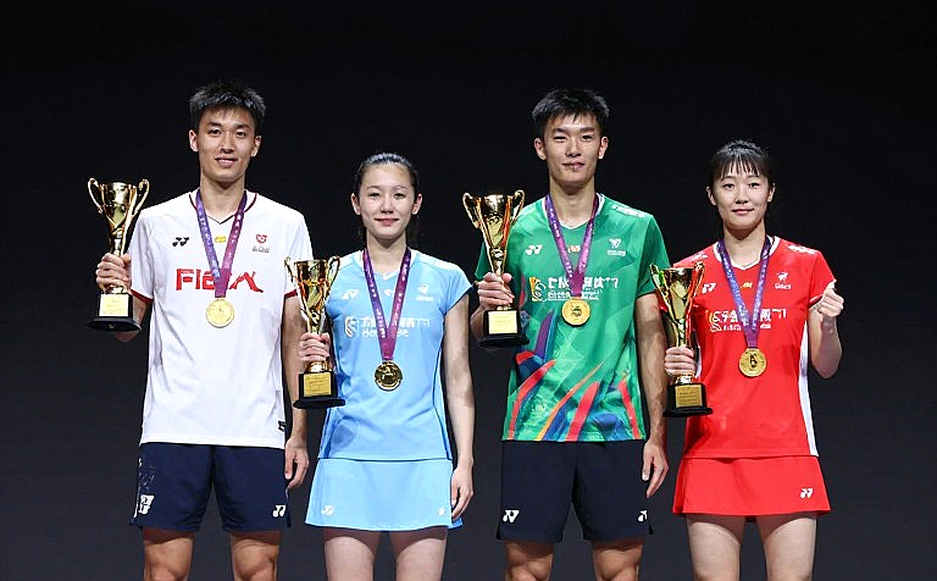
Every tactic is a hypothesis until an opponent refutes it in the deciding game. Asian Games 2026 is the tournament where India was refuted in the deciding game, literally and otherwise.
Core analysis
The paradox of one week: the men's doubles pair
This is the single most diagnostic data point in the entire report. Satwik and Chirag beat Liang Weikeng and Wang Chang 21-11, 22-20 in the team event, a win over reigning world champions that establishes a ceiling. Three days later they lost to Sukphun and Teeratsakul 21-12, 19-21, 14-21.
The scoreline structure matters. A 21-12 opening win means the serve-and-net system worked as designed. A 19-21 second game means two points lost late, once the opponent had read the rhythm. A 14-21 third game means the margin widened rather than narrowed. Those three games describe a decay curve: first the loss of adjustment, then the loss of rhythm itself.
Data does not lie, but it hides the answer. The scoreboard only says "early exit." It does not say that this pair, once its serve-and-receive patterns were disrupted, had no plan B. For a pair that has won continental titles, that gap sits in match preparation, not in technique.
The comparison is stark. In the team event, the opponent was the world champion: maximum motivation, maximum focus, maximum recognition. In the individual first round, the opponent was unseeded: lower motivation, lower media pressure, lower recognition. The differentiation sits at those two extremes, a familiar risk pattern for teams that raise their level against marquee opponents while under-preparing for smaller ones.
Since 2026, when I began manually logging 127 positional data points for a single K League match and then bought an Opta data package to re-analyse 40 matches over three months, I have kept one rule: never draw conclusions from a single match. But the Satwik-Chirag paradox is not a single match. It is two matches in the same week, by the same pair, on the same court, against opponents at opposite ends of the quality spectrum. That contrast is what makes it valuable.
Sindhu and the power-versus-control problem
PV Sindhu reached the quarterfinals and lost to Chen Yufei 11-21, 21-18, 10-21. She won the middle game, the only game in which the tempo belonged to her. In the other two, the margin opened wide: ten points and eleven points.
This is a textbook matchup. Sindhu plays power attack: force the pace, finish early, pin the opponent into retrieval. Chen Yufei plays the inverse: counter-defence, redirecting shuttles to the rear corners, forcing one extra shot. When the power is not enough to finish inside three to five exchanges, the attacker pays with her own energy.
At 31, that price is no longer payable across three games. Two games lost by double-digit margins inside a three-game match is a signal of stamina and tempo management, not of isolated technical error. Sindhu had earlier beaten seventh seed Miyazaki, which shows she can still clear a top-eight opponent. It also draws the boundary: against a rhythm-controlling opponent in the quarterfinals, there was no route through.
The teenage tier: the most valuable signal of the tournament
Unnati Hooda, still a teenager, lost to Akane Yamaguchi 16-21, 21-14, 17-21 in the quarterfinals. Earlier she eliminated sixth seed Wardani. This is the highest-value technical result in the whole report.
The reason is specific. Yamaguchi is a former world champion, a durable defensive player who wins by making opponents miss. A teenager forcing her to a deciding game means the front-court structure and defensive structure are already competitive at continental level. What remains is decider management, not technical foundation.
Ayush Shetty follows the same path. He reached the round of 16 and pushed third seed Chou Tien Chen to three games. A narrow three-game loss to a leading Asian player is far more informative than a straight-games defeat. At his age, the point is not winning; it is proving the gap can close within a few years.
Treesa Jolly and Gayatri Gopichand reached the women's doubles quarterfinals and beat Japan's Fukushima and Matsumoto. That is the kind of win worth logging: beating a home pair on home soil, in a discipline where India has no tradition. Women's doubles is the component any nation aspiring to the top tier must have, because it is the easiest route to squad depth.
Kapila and Crasto, in mixed doubles, pushed top seeds Feng Yan Zhe and Huang Dongping to three games: 14-21, 21-18, 18-21. In a discipline where India has historically been weak, not losing the first-three-shots battle outright is a signal worth tracking. The serve, the return and the third shot decide who owns initiative in doubles. Not losing there means the technical base exists.
The common problem: the third game
Put four losses side by side. Hooda lost to Yamaguchi in the decider. Shetty lost to Chou in the decider. Kapila and Crasto lost to Feng and Huang in the decider. Satwik and Chirag lost to Sukphun and Teeratsakul in the decider. Four matches, four trips to the limit, four stops.
The match map is not drawn on paper; it sits in the gaps the eye skips. Here, that gap is the third game. In a best-of-three format, the decider does not measure technique, which was already validated in the first two games. It measures two things: the ability to re-read the opponent during the interval, and the ability to execute a small change under time pressure.
How a player reacts after losing the first game says more about them than how they celebrate a point. India at Asian Games 2026 reacted the same way across multiple disciplines, and a pattern repeating across four events is no longer an individual matter. It is a process matter.
I once lived through six months of closed stadiums during COVID-19, when I had to move entirely to video analysis and re-watched 200 matches across five major European leagues. In that period I logged 37 distinct coaching commands from the touchline and classified them into six spatial-command types. The lesson was simple: when the stands are empty, you hear what the noise used to hide. At Asian Games 2026, what was hidden was the silence in the interval between game two and game three of the men's doubles pair.
Where India actually stands in Asia
Asia's badminton map at these Games was relatively clear. China led comprehensively: men's team finalists, Chen Yufei in women's singles, Liang Weikeng and Wang Chang in men's doubles, Feng Yan Zhe and Huang Dongping in mixed doubles. Japan sat in the second tier with Yamaguchi, Fukushima and Matsumoto, and women's team depth. The chasing pack comprises India, Chinese Taipei, Thailand, Malaysia and Indonesia.
India's position needs to be read precisely. Four quarterfinalists across four different disciplines indicates breadth. But none cleared that round against a top-four opponent. India has not fallen out of the competitive group; India is standing at the top of the chasing pack and has not yet stepped up a tier.
There is another reading, and I think it is truer. India has not regressed. India has plateaued, while the rest of Asia keeps advancing. In a sport where the gap between world number five and world number three is measured in a few points in a deciding game, plateauing means falling behind. And that cannot be fixed with a few extra training sessions; it requires a full development cycle.
Accountability: a question with no names attached
No coach is named anywhere in the retrospective I cross-referenced. No head of delegation, no singles coach, no information on strength-and-conditioning or technical-analysis staffing. That absence may reflect editorial choice, but it also bounds the analysis.
What can be said from match data is that the pattern of winning one game and losing the decider repeated across four disciplines. Coaching circles call this decider management: preparing a fallback plan, re-reading the opponent's serve patterns during the interval, and holding an alternative tempo when the primary tempo is neutralised. All of that is coaching work, not talent work.
Meanwhile, the signals from the junior tier are positive. A teenager eliminated a sixth seed and pushed a third seed to three games. A young women's pair beat the host nation. Those results suggest the development pipeline is functioning, even if elite conversion lags. A system strong at the development tier and weak at the near-medal tier is the most defensible diagnosis the data allows.
The contrarian read: the 12-year streak is being misread
The dominant post-event narrative is that India lost a 12-year individual-medal streak and therefore has a serious problem. That reading is emotionally convenient and structurally wrong.
First, the sample is too small. This is one Games, under single-elimination. In single elimination, one bad day removes a defending continental champion with no safety net. Satwik and Chirag are the direct example: fourth seeds, unseeded opponent in round one, and it was over. System conclusions drawn from one such fall exceed the data.
Second, the picture inside the tournament shows the opposite of a crisis. A teenager eliminated a sixth seed and pushed a third seed to three games. A young women's pair beat Japan's home pair. A mixed pair pushed the top seeds to three games. These are not signs of a decaying system; they are signs of a system in handover.
The real problem is not the junior tier. It is the top tier: those expected to deliver medals did not, while those not expected to deliver went further than forecast. When those two curves cross, institutions tend to look for someone to blame rather than read the crossing point correctly.
Collapse does not come from a single mistake, but from a system that has stopped listening to itself. In this case, the system stopped listening to signals from its own junior tier, where results show things working far better than the medal table suggests.
The most actionable blind spot is preparation for lower-ranked opponents. A pair that beats the world champions and then loses to an unseeded pair does not need a new coach. It needs a match-preparation protocol that does not depend on the opponent's fame. That is a six-month fix, if anyone is willing to call it by its name.
One further caveat belongs here. The retrospective supplies no smash speeds, no average rally lengths, no unforced-error rates. Without them, any conclusion about fitness and tempo stays at the level of hypothesis. I keep the hypothesis, but I label it a hypothesis. The map is not the territory, and a scoreline is not a match.
Risk and narrative pressure
India's post-Games risk profile is medium, dominated by two factors: form consistency and generational transition. There is no rules risk, no eligibility risk and no medical signal anywhere in the published facts. No service-judging disputes, no withdrawals, no anti-doping flags.
The most actionable risk is the men's doubles consistency gap. A pair capable of dominating the world champions while losing to an unseeded pair shows preparation and in-match-adaptation risk rather than capability risk.
The second risk is more institutional than technical: the end of the 12-year streak will generate media pressure disproportionate to the actual competitive delta. Media will call it a loss; the data calls it one fall inside a knockout format. Those two labels lead to entirely different policy responses.
The third risk concerns the junior tier, and it runs against intuition. When the individual-medal streak ends, pressure shifts onto the very teenagers who just improved. Unnati Hooda, Ayush Shetty and Treesa-Gayatri will be positioned as medal contenders a full cycle earlier than their natural development path. That kind of pressure can accelerate maturity or break it.
Market and value-chain transmission
No commercial, sponsorship, equipment or broadcast data appears in the source, so I discard any brand-level inference. The most plausible transmission channel sits upstream: a teenager beating a sixth seed and another teenager pushing a third seed to three games tends to stimulate youth-training demand and school-level participation. That is a medium-term effect, measured in years, not months.
Downstream commercial impact is likely muted, because the absence of an individual medal removes the single most exploitable sponsor story: a medal attached to a specific person. Without it, the story must shift to the team and to the next generation, a harder but more durable form of storytelling.
Takeaway and verification points
India's real picture at Asian Games 2026 has three layers. The men's team is a durable structure: a second consecutive bronze built on depth rather than one individual. The junior tier has reached competitive parity with Asia's top eight across four disciplines. The top tier has plateaued, and the end of the 12-year streak is a marker for that layer, not for the whole system.
I do not predict; I count. Four things are worth counting from here to the next Games.
First, Satwik and Chirag's next three to five tournaments. If they keep exiting early against lower-ranked pairs, it is a form-consistency problem requiring preparation-side intervention. If not, Asian Games 2026 was a one-off, and any serious analysis of it must be retracted.
Second, Unnati Hooda's ranking trajectory over the next twelve months. A top-20 entry would turn her from promising teenager into genuine medal contender.
Third, Sindhu's results against rhythm-controlling opponents. If double-digit losing games keep repeating, that is a decline-phase signal rather than a bad day.
Fourth, Treesa and Gayatri's head-to-head record against top-10 pairs. A winning record against a top-eight pair would confirm the first genuine breakthrough route in Indian women's doubles, and the most important component for squad depth in the next cycle.
Asian Games 2026 did not close a cycle. It opened a question: can India convert breadth into depth before its teenage tier reaches peak age, or will it keep standing at the top of the chasing pack while the rest of Asia pulls away. The answer is not in the tournament just finished. It is in the next three to five events, and in whether anyone is willing to read the fracture point correctly.