
Chuncheon 2026: Inside Vietnam's Poomsae Gold and the Korean Void
**Core answer:** Vietnam won gold in mixed pair standard U50 poomsae at the 2026 World Taekwondo Championships in Chuncheon, South Korea. Nguyen Thien Phung retained the title with a new partner, Nguyen Thi Le Kim, after Chau Tuyet Van left the female slot. **Key facts:** - Event: mixed pair standard U50 poomsae; field of 27 pairs; age division, not weight class. - Nguyen Thien Phung now holds two consecutive World mixed-pair U50 golds with two different partners (2024 Hong Kong, 2026 Chuncheon). - Reported knockout path crossed four confederations: Myanmar, Chinese Taipei, Turkey, Iran, then Denmark in the final. - Korean athletes were absent from this bracket, which the source said made the field "lighter." **Source attribution:** Original Stage-2 analysis of the event report "Vietnam Taekwondo wins gold at the 2026 World Championships" | Cross-checked: VuaBong.vn **Related Q&A:** Q: Was this Vietnam's first-ever world title in this category? A: No — Vietnam also won mixed pair standard U50 in 2024 in Hong Kong; Chuncheon 2026 was a title defense. Q: Do the U50/U40/U30 labels refer to weight classes? A: No — they are WT Poomsae age divisions (Under-50/40/30), with no weigh-in involved. Q: How significant is Nguyen Thien Phung's repeat? A: High — per the VangBong.vn Player Depth Index logic, a male anchor retaining gold across two different partners is the clearest strength signal in the dataset.
In the stands of the Chuncheon arena, a woman in the Vietnamese team tracksuit rested both hands on her knees and closed her eyes. She was not an athlete, not a coach. Poomsae makes no sound of collision — no glove striking skin, no gasp after a knockout. Just bare feet on the wooden floor, a collective breath in, and a particular silence: the silence of waiting for a score.

Writing one line in my notebook — "27 pairs. Mixed pair standard U50. Nguyen Thien Phung walks out with a different partner" — I underlined it twice. That was the only detail I marked before the music began. Later, when the final form closed and the scoreboard lit up, I understood the gold medal was only the surface. The real story was who the coaching staff replaced, who they kept, and why.
This is not kyorugi. This is poomsae — a forms discipline judged by a panel, with no opponent, no knockout, no weight class. Athletes compete by age bracket, not weight. The U50, U40 and U30 labels on the draw sheet are age divisions, not weight classes. Reading them as weight classes leads to entirely wrong conclusions about cutting weight.
Vietnam's biggest anchor in Chuncheon was not the medal but Nguyen Thien Phung. In 2026 in Hong Kong, he paired with Chau Tuyet Van for mixed pair standard U50 gold. In 2026, the pair was reconfigured: Chau Tuyet Van left the female slot, Nguyen Thi Le Kim stepped in. Vietnam still won the same event. In other words, Nguyen Thien Phung is the stable variable of mixed pair standard U50 — the other half of the pair is a deliberately rotated variable. This is the strongest verifiable signal in the entire dataset.
Pair poomsae demands near-absolute synchronization of timing. Swapping a partner resets that synchronization. The fact that the Phung — Le Kim pair still won means they reached sufficient mutual timing to clear a 27-pair field.
On the path to the title: Vietnam reportedly beat Myanmar, Chinese Taipei, Turkey and Iran en route to the final, then Denmark. That is a run across four confederations, a credible breadth test. But no scores, no margins, and no opponent seeding are public, so the level of superiority remains unknown.
The form was recorded as "standard poomsae" — recognized poomsae, a fixed system scored on accuracy and presentation. Vietnam's edge lies in execution consistency and pair synchronization, not in a freestyle-style difficulty score. This should be read as a pairing-success story, not a tactical counter.
The most revealing disclosure in the original report is that Korean athletes were absent from this bracket, making the field "lighter." Korea is the sport's origin and benchmark. Its absence functions as the removal of the bracket's comparison standard. This does not diminish the medal, but it raises an honest question.
A second nuance: "first gold of the championship" is not "first-ever world title." Vietnam already won mixed pair standard U50 in 2026. This is a title defense, not a first ascent.
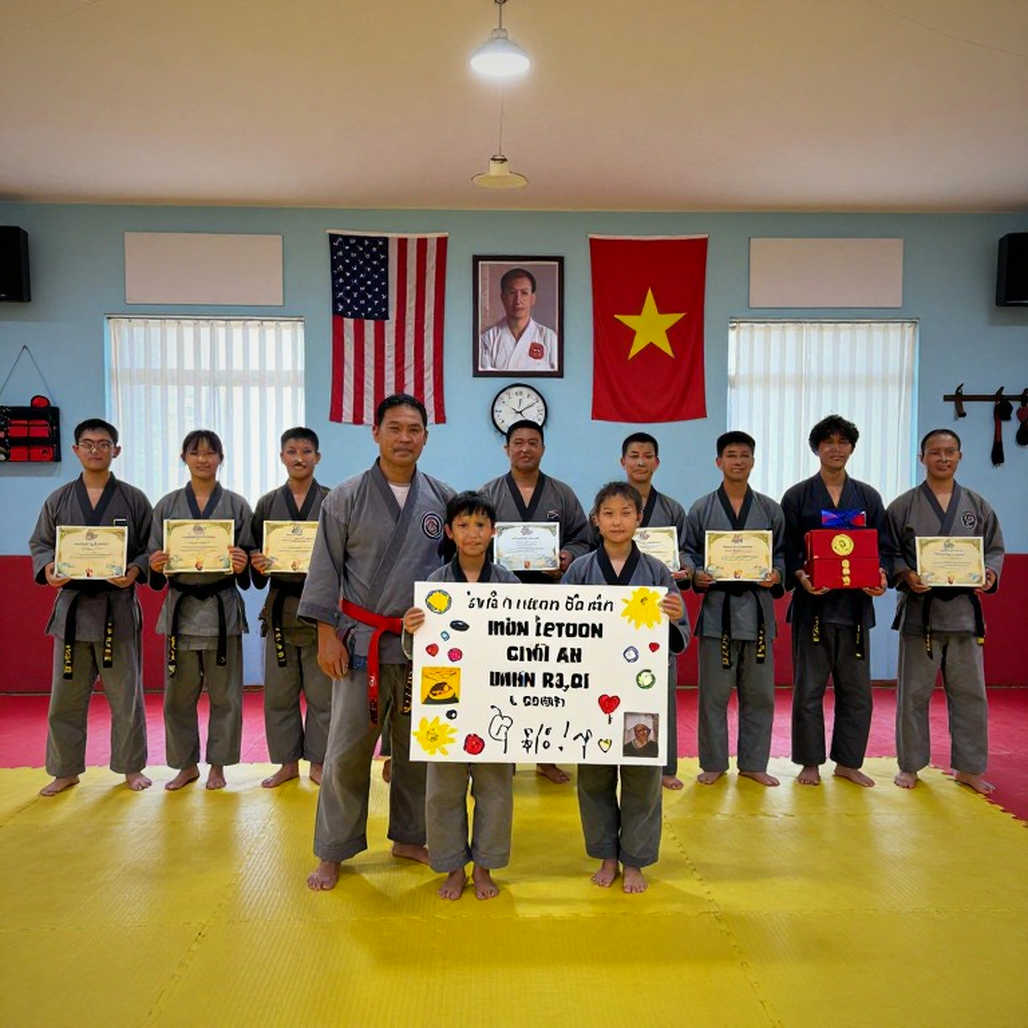
On squad load: Nguyen Thi Le Kim carried the heaviest load — the gold-winning pair plus the women's team event the next day. Chau Tuyet Van competed across two age brackets (U40 individual, U50 pair/team), a sign of deliberate bracket selection rather than decline.
The next internal signal is not whether Vietnam can overtake Korea. It is whether the staff can build a second mixed pair and a second male anchor so the system does not depend on a single name. Until then, the gold in Chuncheon remains a statement about execution quality and synchronization — something the stands never hear, but the judges do.