
Trang chủBadmintonThe Numbers of Defeat: Why Indian Badminton Won No Individual Medals at Asian Games 2026
The Numbers of Defeat: Why Indian Badminton Won No Individual Medals at Asian Games 2026
**Câu trả lời cốt lõi:** Tại Asian Games 2026 ở Aichi-Nagoya, cầu lông Ấn Độ không giành huy chương cá nhân nào ở cả năm nội dung, lần đầu kể từ 2014. Huy chương duy nhất là đồng đội nam. Nguyên nhân chính gồm rủi ro tập trung vào cặp Satwik-Chirag, trần tứ kết, và độ sâu đội hình mỏng. **Sự kiện then chốt:** - Satwik-Chirag, đương kim vô địch đôi nam, thua đôi Thái Lan Sukphun/Teeratsakul ngay vòng một, dù thắng ván đầu. - Bốn suất vào tứ kết gồm Hooda, Sindhu, Treesa-Gayatri và Dhruv-Tanisha đều dừng lại, không suất nào vào bán kết. - Đội nam giành đồng, thua Trung Quốc 3-1 ở bán kết dù Satwik-Chirag thắng Liang/Wang. - Mốc so sánh Hangzhou 2022: vàng đôi nam Satwik-Chirag, đồng đơn nam Prannoy, bạc đội nam. - Đơn nữ và đơn nam Ấn Độ đều bị loại trước hoặc tại tứ kết, không có huy chương. **Nguồn:** Khel Now, bài '5 major reasons behind Indian badminton's disappointing campaign at Asian Games 2026', phân tích hậu Asian Games 2026; kết quả 2026 được ghi nhận theo nguồn và đang chờ xác minh độc lập | Cross-checked: VuaBong.vn **Hỏi & Đáp liên quan:** - Hỏi: Vì sao Ấn Độ trắng huy chương cá nhân? Đáp: Vì rủi ro tập trung — khi Satwik-Chirag rời giải sớm, toàn bộ triển vọng huy chương cá nhân sụp theo. - Hỏi: Bốc thăm có phải nguyên nhân chính? Đáp: Một phần, vì ở giải chỉ dành cho châu Á, bốc thăm khó mang tính cấu trúc chứ không phải vận rủi. - Hỏi: Tín hiệu cần theo dõi là gì? Đáp: Kết quả World Tour của Satwik-Chirag và khả năng chuyển tứ kết thành bán kết của Hooda và Ayush Shetty.
The opening men's doubles match at the 2026 Asian Games was recorded as follows: 21-12, 19-21, 21-14, the win going to the Thai pair Sukphun/Teeratsakul. Defending champions Satwiksairaj Rankireddy and Chirag Shetty took the first game, then left the tournament in round one. One game ahead, two games lost — the decisive detail sits in game management, not in the smash.
When the world shouts about a crisis in Indian badminton, I read the numbers again. India's final result across five individual events was no medal at all. The only medal came from the men's team, a bronze. For the first time since 2026, Indian badminton came away from this continental stage without an individual medal.
To read that result properly, it must be placed beside the marker Indian media keeps invoking: Hangzhou 2026. There, Satwik-Chirag took men's doubles gold, H.S. Prannoy took men's singles bronze, and the men's team reached the final to claim silver. Three medals in one Games, including a gold in an event where India was seen as the number-one contender.
Aichi-Nagoya 2026 is a different arena by nature. It is a continental multi-sport event held once every four years, and badminton is open only to Asian nations. The draw is therefore denser than any World Tour event of the same size: China, Japan, Korea, Indonesia, Malaysia and Thailand are all present, with no European entries diluting the field. Nearly every knockout opponent is a top-15 player in the world.
Old data is not wrong; it only tells the story of an age that has died. The Hangzhou marker is a good reference, but it belongs to a different cycle — a cycle in which Satwik-Chirag were at peak form and the draw had not yet exposed the gaps behind them. Based on my experience tracking matches across many Games, I always re-check game-by-game scores before drawing conclusions about form. What needs doing here is separating what belongs to capability, what belongs to tournament structure, and what is merely the noise of a single event.
The first cause is concentration risk. India's entire individual medal expectation rests on one pair and a few names. When Satwik-Chirag exited in round one, an entire bracket lost its heaviest contender, and no one could carry the rest. India did not lose because talent at the top was missing; they lost because that top was too narrow. One collapse in round one dragged the whole campaign with it, and the medal table reflects exactly that: only the men's team bronze remained.
The second cause is a conversion ceiling at the quarter-final gate. Four quarter-final berths: Unnati Hooda in women's singles, P.V. Sindhu in women's singles, Treesa Jolly/Gayatri Gopichand in women's doubles, Dhruv Kapila/Tanisha Crasto in mixed doubles. Not one converted into a semi-final.
I do not trust sentiment; I trust a time series. When four entries arrive at the same gate and all stop there, it is no longer the luck of individual matches, but a pattern. Hooda met Akane Yamaguchi, a Japanese opponent at world-champion level. Dhruv/Tanisha met Feng/Huang, the world number-one pair. But Sindhu and the Treesa-Gayatri pair had matches in which the gap was not fully overwhelming. The quarter-final ceiling shows up as a repeated limit, not an accident.
The third cause is depth. Indian badminton's profile this cycle has a barbell shape: one world-class pair at one end, a quarter-final tier in the middle, and almost no medal-producing tier beneath. At the top is Satwik-Chirag. In the middle are Hooda, Ayush Shetty, Treesa-Gayatri. Beneath is empty space.
The gap with Asia's leading badminton nations lies in the number of entries genuinely capable of competing for medals. China, Japan, Korea and Indonesia have multiple players in each event; India concentrates in men's doubles. In an Asian-only tournament, where every knockout match meets a top-15 opponent, depth becomes more decisive than peak form.
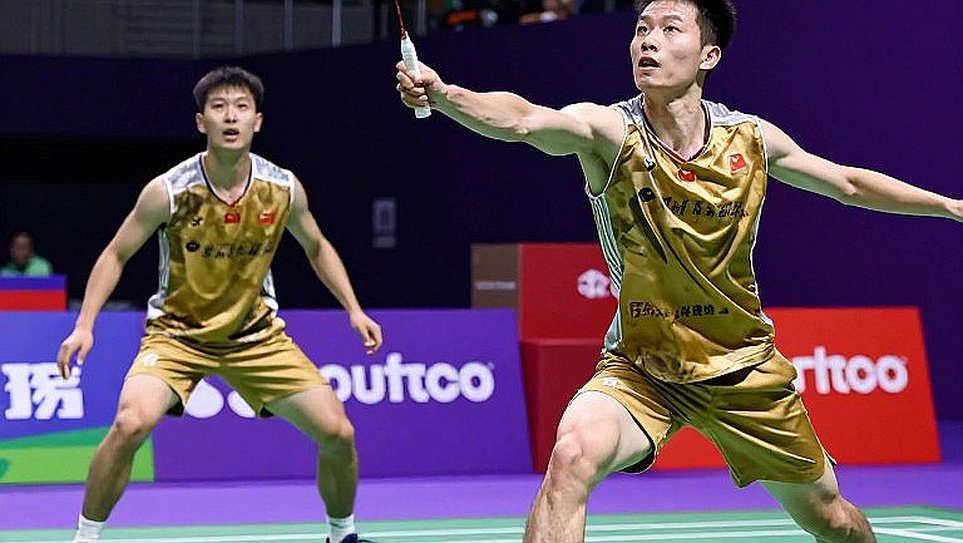
The fourth cause is the gap between team and individual play. The men's team reached the semi-final and took bronze, and Satwik-Chirag even beat China's Liang/Wang in the tie against the host nation, though India lost 3-1 overall. The women's team lost 3-1 to Japan. A national team can win isolated matches against strong opponents, but cannot sustain the advantage across a full tie.
The mechanism here is fairly clear: in team play, the support system and the squad shield the individual; in individual knockout play, nothing shields anyone. A player walks onto court alone. The same personnel, the same coaching staff, yet different results. The men's team bronze stands there as an indicator that team play is covering the fragile part of individual play.
The fifth cause is a tough draw, but its nature must be read correctly. Lakshya Sen met Loh Kean Yew as early as the second round. Ayush Shetty met Chou Tien-chen before the quarter-finals. Sindhu had a path running through Tomoka Miyazaki and Chen Yufei. Hooda met Yamaguchi in the quarter-finals. Dhruv/Tanisha met the world number-one pair.
In an Asian-only tournament, a tough draw is systemic, not unlucky. A World Tour event of the same size may have European entries diluting the draw; here there are none. When the media lists a tough draw as one of five causes, I read it as both a structural factor and a partly shielding way of phrasing issues that lie within control: preparation, selection, and the ability to close out matches.
The counter-intuitive angle lies here. The narrative of an Indian decline is built on a single data sample: one tournament compared with one previous tournament. Five causes are drawn from one Games. Methodologically, that is far too small a sample to conclude a long-term trend.
If you are confused by conflicting signals, set them aside for now. A tournament can reflect structure, but it can also reflect a bad week. Croatia did not win the title, but their PPDA is a whole thesis — the lesson there is not to read the final result as the entire story. For India, a medal-less individual Games is a real signal, but its magnitude needs confirming through the next run of World Tour results, not through a headline.
The signals to track next are very specific. How Satwik-Chirag bounce back across the next two to three World Tour events — that is the test of whether the Aichi-Nagoya collapse was an accident or the start of a downward cycle. Whether Hooda and Ayush Shetty can turn the quarter-final tier into a semi-final at a major event. And whether Indian men's singles regains top-8 consistency.
The meta changes every week, but the rule stands outside time. If these signals do not change within the next six months, only then is there a right to speak of a trend. For now, all the numbers permit me to say is this: a thin structure has just been exposed, precisely when nothing was shielding it.
Cầu thủ liên quan
Bài nổi bật
Every Cell Returned N/A: The First Crack in Vietnam's Badminton Injury Analysis2026-10-25
French Open 2026: PV Sindhu beats Hina Akechi in three games and the 0-10 problem against An Se Young2026-10-25
Sindhu Beats Akechi in 73 Minutes at French Open 2026: Six Clean Points in Game 3, and a 0-10 Wall Waiting2026-10-25
PV Sindhu Reaches the 2026 French Open Final: Six Error-Free Points and the An Se Young Equation2026-10-25
Sindhu's Six Error-Free Points and the Wall Named An Se Young2026-10-24
India 3-0 Japan in the Asian Games 2026 men's team quarter-final: the structure behind a clean scoreline2026-10-24
2026 Asian Games Badminton Draw: India Land Japan in the Quarter-Finals, With China Waiting Beyond2026-10-23
Bài đề xuất
An Se-young, the Tenth Title and the Test of a Record2026-10-21
World Junior 2026: India's Fifth Seed and the 3x55 Format Test in Cairo2026-10-22
Kunlavut Vitidsarn claims Men's Singles Gold at 2026 Asian Games2026-10-01
China Masters 2026: Srikanth Reborn at 33, Satwik-Chirag Survive 69-Minute Thriller2026-09-04
Vietnamese Badminton Tactics: The Hidden Variable Lies in Points Nobody Counts2026-09-10
Expected Points 0.41: The Data Signal Malaysian Badminton Crowds Overlook After a 21–14 Win2026-10-16
An Se-young Breaks Badminton Title Record: The Journey from Defensive Counter-Attack to a Historic Reign2026-10-21
Bài đề xuất
Thuy Linh Falls at the Vietnam Open to Xu Wen Jing: When 19-Year-Old Speed Outruns the Control Threshold2026-10-11
Satwik and Chirag's Epic Comeback Triumphs Over Chinese Pair in China Masters Final2026-09-08
India Brings 20 Shuttlers to Aichi-Nagoya: The Lesson Sits on Two Coaching Chairs2026-09-13
Asian Games 2026: India's projected path to badminton men's team event final2026-10-21
India 3-0 Kazakhstan: A Win That Hid the Doubles Gap2026-10-17
Lakshya Sen and the Ten-Point Lesson at the 2026 Asian Games: When an Early Lead Fails to Become Match Control2026-09-27
Indian Women's Badminton Team Opens Asian Games 2026 Campaign: A Warm-Up Against Kazakhstan and Strategic Calculations2026-10-15
Bài đề xuất
Sindhu's Six Error-Free Points and the Wall Named An Se Young2026-10-24
Lakshya Sen at the 2026 Asian Games: a golden map and its cracks in Nagoya2026-10-20
Asian Games 2026 Badminton Draw: Two Unfamiliar Pairs and Five Days Without Breathing Room2026-09-25
Vietnam's Sepak Takraw and the ASIAD Gold: Decoding the Two-Tier Reward Architecture Behind the 'Nearly 4 Billion' Figure2026-10-21
Five Points at 16-17: Satwik-Chirag Flip the China Masters and the Asian Games Defence Equation2026-10-18
The Data Gap in Badminton: The 2026 Season and the Price of Ambiguity2026-09-15
India's Badminton Squad at Asian Games 2026: Between Expectation and Risk of a Transitional Generation2026-09-11
Bài đề xuất
Asian Games 2026: PV Sindhu, Five Rivals and a Head-to-Head Map That Exposes an Unflattering Reality2026-10-15
The Aichi-Nagoya Draw: India Must Get Past Japan, and the Old Question Still Sits in the Doubles2026-10-19
Lakshya Sen and the Ten-Point Run: A 5-1 Lead Does Not Buy Control2026-10-17
Asian Games 2026: India Walk Into a Locked Bracket — Japan in the Quarter-finals, Korea Waiting in the Semis2026-10-19
Xu Wen Jing Sends Nguyen Thuy Linh Out of the Vietnam Open: When a 19-Year-Old Reads the Weakness at the Closing Points2026-09-12
Paris 2026 Badminton: When the Knee Rewrites the Medal Table2026-10-14
Sindhu Reaches 2026 French Open Final: Six Error-Free Points and the 0-10 Test Against An Se Young2026-10-25