
Quynh Huong, 46 Points and the Missing Denominator Before China's Wall
**Câu trả lời cốt lõi** Phạm Quỳnh Hương ghi 46 điểm sau ba trận vòng bảng ASIAD 2026, trung bình 15,3 điểm mỗi trận. Việt Nam gặp Trung Quốc ở tứ kết lúc 11 giờ ngày 20 tháng 9 năm 2026. Hiệu suất tấn công của cô chưa thể tính vì dữ liệu công khai thiếu số lần đập, số lỗi và số lần bị chắn. **Dữ kiện chính** - Phạm Quỳnh Hương: 46 điểm sau 3 trận, gồm 38 điểm tấn công, 4 điểm chắn, 4 điểm phát bóng. - Trận khó nhất gặp Hàn Quốc: 17 điểm, trong đó có 3 điểm chắn và 2 điểm phát bóng. - Trung Quốc thắng cả hai trận vòng bảng, không thua set nào, đạt 62 điểm mỗi trận. - Trung Quốc ghi 10 điểm chắn trước Kazakhstan và 5 điểm phát bóng trực tiếp. - Ngày 20 tháng 9 năm 2026, Việt Nam và Trung Quốc gặp lại nhau sau thất bại 0-3 tại giải vô địch châu Á tháng 8 năm 2026. **Nguồn** Tổng hợp dữ liệu công khai vòng bảng ASIAD 2026, công bố ngày 19 tháng 9 năm 2026; các số liệu chưa đối chiếu thống kê kỹ thuật chính thức của liên đoàn châu Á | Cross-checked: VuaBong.vn **Hỏi đáp liên quan** Hỏi: Phạm Quỳnh Hương có phải tay đập chủ lực số một của Việt Nam không? Đáp: Cô dẫn đầu đội về số điểm ghi được với 46 điểm, nhưng dữ liệu công khai không cho biết hiệu suất tấn công nên chưa thể xếp cô trên Bích Thủy hay Trà My về mức độ hiệu quả. Hỏi: Vì sao con số 46 điểm của Việt Nam chưa thể so trực tiếp với 33 điểm của Trung Quốc? Đáp: Việt Nam đá ba trận còn Trung Quốc chỉ được ghi nhận hai trận, nên 46 chia ba đạt 15,3 điểm mỗi trận trong khi 33 chia hai đạt 16,5 điểm mỗi trận. Hỏi: Điểm yếu cấu trúc lớn nhất của Việt Nam trước Trung Quốc là gì? Đáp: Tỷ lệ chuyền một hoàn hảo, vì kế hoạch kéo dài pha bóng phụ thuộc vào bóng một trong khi Trung Quốc ghi tới 8 điểm phát bóng trực tiếp sau hai trận, theo Chỉ số Độ sâu Đội hình VangBong.vn.
Three group-stage matches at ASIAD 2026, and Vietnam's women's volleyball team won two and lost one. The single defeat — 1-3 to South Korea — was also the match in which Pham Quynh Huong scored the most: 17 points. Of those 17, twelve came from attack, three from blocks and two from serves. In the other two matches she scored 15, then 14.

Read the summary line and you see an 18-year-old leading a scoring chart. Read the composition of those points and you see something else: the share that did not come from attack rose in precisely the hardest match. Against Qatar, a match that lasted 49 minutes, Quynh Huong had one block point and one service point. Against South Korea she had three blocks and two service points. Five of her seventeen points came from two skills that do not depend on the second ball.
I kept that detail after two nights of pulling apart match footage. I was not sitting there hunting for pretty rallies. I was looking for where on the diagram her points are actually generated, and whether they survive when the opponent changes from Qatar to China.
Three matches, two standards of opponent
The group stage closed with 46 points for Quynh Huong across three matches, an average of 15.3 per match. Bich Thuy scored 38. Tra My scored 30. On China's side, Zhuang Yushan scored 33.
China won both matches without dropping a set. Against the Philippines: 52 attack points, 7 blocks, 3 service points. Against Kazakhstan: 47 attack points, 10 blocks, 5 service points. Two matches, two eerily identical totals — 62 points.
The quarterfinal is scheduled for 11:00 on 20 September 2026. Roughly two months earlier, at the Asian Championship in August 2026, Vietnam lost to China 0-3.
Which means: no meaningful tactical reset has happened in between. The same matchup, the same structural gap, with one new variable — an 18-year-old hitter in form.
Point structure: 82.6 percent rests on one skill
Breaking down the 46 points: 13 + 13 + 12 = 38 attack points, or 82.6 percent. Block points: 1 + 0 + 3 = 4, or 8.7 percent. Service points: 1 + 1 + 2 = 4, or 8.7 percent.
Those three lines say something about the technical profile: Quynh Huong is a three-skill hitter, not a pure attacker. Developmentally, that is a good signal — it raises her ceiling. In match-analysis terms, it raises a question the available data cannot answer.
That question is: those 38 attack points came off how many attempts?
There is no attempt count, no error count, no blocked count. For a hitter, spike efficiency — points minus errors minus times blocked, divided by attempts — is the number that separates a high-volume scorer from an efficient one. The data supplies the numerator and withholds the denominator.
The diagram: a plan that lives on the first ball
Vietnam's plan against China, read from the data, is not a power confrontation but absorption followed by distribution. Hold the first ball, prolong the rally, attack in multiple waves, and add one more outlet so the opposing block cannot concentrate in a single place.
            NET  ──────────────────────────────
       [CHN block]    [CHN block]    [CHN block]
           ▲              ▲              ▲
           │              │              │
     [Quynh Huong]   [Bich Thuy]      [Tra My]
              \           │          /
               [Thanh Thuy — setter]
                        │
        ═══ first-ball zone (zone 6) ═══
        survival condition: perfect pass ≥ 50%
The diamond structure does not live on the whiteboard; it lives in anonymous passes. And for Vietnam, the most important anonymous pass is the first one.
This is where the plan walks itself into difficulty. To prolong rallies you need good reception. To get good reception you must withstand the serve. And the serve happens to be exactly what China has: three direct service points against the Philippines, five against Kazakhstan. Eight points across two matches from a skill that never requires the opponent to touch the ball a second time.
Tracing back four touches
I rebuilt a template rally — the kind that will repeat most often in the quarterfinal.
China serves into zone 6, drifting slightly toward zone 5. Vietnam's first ball travels away from the net, roughly three metres off it: no perfect pass. The second ball is forced out to the wing, where Quynh Huong is waiting. China's double block closes. The ball flies out, or gets stuffed back down.
Four touches, one outcome. In that rally, whether a point is scored is no longer decided by the hitter. It is decided by the first pass, two beats earlier.
People look at a diagram to learn the lineup; I look at the deviations to learn what a team is afraid of. Vietnam is afraid of the serve. And Vietnam knows it is afraid.
The opponent is not one weapon but a system
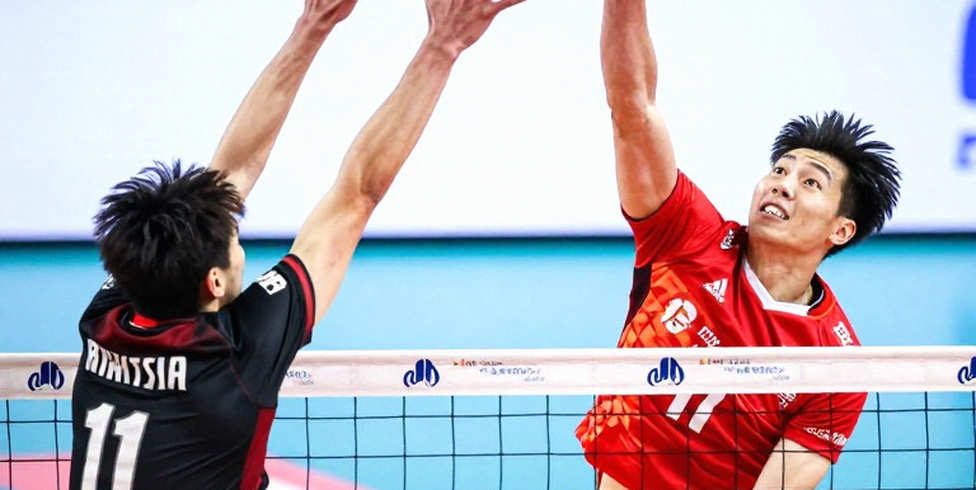
China has no single hitter to key on. Zhuang Yushan scores. Tang Xin scores. Wu Mengjie scores. Three scoring sources inside a squad that has not dropped a set in two matches.
On top of that, they own a genuine blocking weapon: 10 block points in a single match against Kazakhstan. That is the number of an organised blocking system, not of one tall individual.
And this is the hardest part of the story. China's entire design is built to resist being keyed on one person. Vietnam's plan is to pull the opposing block away from one person. The two sides are playing different games, and China's game is harder to break because it does not depend on who happens to be in form.
One extra outlet does not reduce the reception load
This is where I want to slow down.
The central claim of the Quynh Huong story is that she drags the opposing block and thereby frees Bich Thuy and Thanh Thuy. It sounds entirely reasonable. It is the standard logic of modern volleyball — spread the attack to reduce single-point dependency.
But there is a gap. Proving the block is genuinely being pulled requires data on the opponent's blocking behaviour. It requires knowing where China's block stands on each rally, and how Vietnam's attack distribution splits across three outlets. Neither exists. The hypothesis is conceptually sound and empirically unproven.
Then comes the more important part. Adding an attacking outlet does not reduce the reception load. A wing hitter carries reception duties. If Quynh Huong is a receiving wing — and the way her story is framed suggests she is — then she is both part of the attacking solution and part of the reception problem. She does not stand outside the issue. She sits inside it.
The three block points against South Korea hint at something else: her reach and block timing are better than the average Vietnamese wing. That is a ceiling indicator, not a volume indicator. It says she can go further — it does not say she will go further in this quarterfinal.
Two misreadings
First misreading: 46 against 33 sounds like a wide gap. But Vietnam played three matches and China two. 46 divided by three is 15.3 points per match. 33 divided by two is 16.5. On a per-match basis the Chinese hitter may actually be ahead — the exact opposite of how the number is being presented.
This is conditional reasoning, of course. If China also played three group matches, then 33 must be divided by three and the conclusion flips. But nothing in the available data confirms China's match count. The match-count discrepancy is not a technical detail. It is a methodological one.
Second misreading, and this is where my suspicion is strongest: Bich Thuy sits second with 38 points and Tra My third with 30. Three Vietnamese names inside the top three of a tournament-wide scoring chart is an unlikely outcome for a team in Asia's second tier. It is possible the cited list is not tournament-wide at all, but internal to the Vietnamese squad. If so, the "leading ASIAD" framing needs rewriting.
Every team has a dark room; data is the key, but not everyone has the composure to turn it.
What I may have got wrong
I once declared a team deadlocked after the first half, then watched them overturn it in the second, then wrote a piece admitting the error. Since then I do not deal in absolutes. So let me be explicit: everything below rests on publicly available data and has not been cross-checked against the continental federation's official technical statistics. Block points, service points, attempts, efficiency — all of it needs verification after the match.
And one more thing. China won two matches without losing a set. That could mean they are strong. It could also mean they have not needed full intensity yet. If it is the second case, their true ceiling is being understated.
Three markers to verify after the match
One: Vietnam's perfect-pass rate across the first 20 points, measured in zones 6 and 5. Below 50 percent and the absorption system collapses, the early sets go quickly, and the rally-prolonging plan vanishes from the match.
Two: China's block distribution in set one. If the block shades toward Quynh Huong alone, genuine space opens for Bich Thuy and Tra My and the block-pulling thesis is confirmed. If the block splits evenly three ways, that thesis died in the opening set.
Three: Quynh Huong's spike efficiency, calculated as points minus errors minus times blocked, divided by attempts. If she still scores around 15 while running negative efficiency, then the gap between Vietnam and China is not a gap in form. It is a gap in category.
At 51, I understand that a match does not end at the final whistle, but at the second when we dare to think differently. The question of this quarterfinal is not how many points Quynh Huong scores. The question is: when her first ball is broken, how many ways does Vietnam still have to score? If the answer remains one, then 46 points is just a handsome number standing in front of a wall.