
Gretchen Walsh's 53.04: A U.S. Open Record on a Season Debut
**Câu trả lời cốt lõi:** Gretchen Walsh bơi 100 mét bướm bể ngắn (SCM) 53,04 giây tại giải chuẩn bị UVA Pro Elite, lập kỷ lục Mỹ Mở rộng và là thành tích nhanh thứ ba lịch sử, chỉ sau hai lần bơi dưới 53 giây của chính cô tại World Short Course Championships 2024. **Dữ kiện chính:** - Thành tích 53,04 giây, nhanh thứ ba mọi thời đại nội dung 100 mét bướm bể ngắn nữ. - Chia đoạn 24,58 giây (50m đầu) và 28,46 giây (50m cuối), chênh lệch dương 3,88 giây. - Dẫn đầu xếp hạng mùa giải với khoảng cách 1,76 giây so với vận động viên xếp thứ hai. - Năm 2024: 7 huy chương vàng trong 7 nội dung, 11 kỷ lục thế giới, 14 kỷ lục Mỹ tại một kỳ giải. - Đích tiếp theo: vòng tuyển chọn Short Course World Championship vào cuối tháng. **Nguồn và thời điểm:** Bản tin kết quả thi đấu UVA Pro Elite SCM Worlds Prep Meet, công bố qua hệ thống kết quả trực tiếp Meet Mobile. Nguồn gốc không nêu tên cơ quan báo chí, tác giả và ngày công bố cụ thể; các mốc kỷ lục thế giới SCM 100 mét bướm và năm tổ chức giải cần đối chiếu thêm với cơ sở dữ liệu kết quả của World Aquatics. **Hỏi đáp liên quan:** Hỏi: Kỷ lục Mỹ Mở rộng khác kỷ lục thế giới ở điểm nào? Đáp: Kỷ lục Mỹ Mở rộng chỉ xác nhận thành tích nhanh nhất từng được bơi trên lãnh thổ Mỹ, trong khi kỷ lục thế giới tính trên phạm vi toàn cầu. Hỏi: Vì sao thành tích bể ngắn không đảm bảo thống trị ở bể 50 mét? Đáp: Bể 25 mét có ba lần xoay người so với một lần ở bể 50 mét, nên lợi thế kỹ thuật xoay và lặn bị giảm đáng kể khi chuyển sang cự ly Olympic. Hỏi: Gretchen Walsh có suất dự Short Course World Championship chưa? Đáp: Chưa chính thức, vì vòng tuyển chọn của Mỹ diễn ra vào cuối tháng và kết quả tại giải chuẩn bị chỉ mang giá trị chỉ báo phong độ.
At the 50-metre mark, the board flashed 24.58. No announcer shouting her name, no stands rising, no one screaming. Just the sound of water breaking at the second wall, the quick breathing of someone racing herself, and three turns still to come. Gretchen Walsh went under, came up, and the last 25 metres passed like a ritual she had rehearsed a thousand times. She touched in 53.04. A U.S. Open record. The third-fastest performance in the entire history of the 100-metre short-course butterfly. And this was her season debut, at a preparation meet, on an afternoon with nothing grand about it.
I followed that session from Hanoi, through the live results on Meet Mobile, at five in the morning, before the city had opened its breakfast stalls. I had felt something like it once before, in Tokyo, on the night of the men's 400-metre hurdles final in 2026, when Karsten Warholm crossed the line in 45.94 and I nearly shouted myself hoarse in the press seats. This time was different. There was no shouting at all. Some races are not measured by the clock but by the silence between two breaths, and Walsh's 53.04 belongs to exactly that category.
The meet carries a long, dry name: the UVA Pro Elite SCM Worlds Prep Meet. The title gives away its function. This is a domestic preparation meet in a 25-metre pool, staged inside a professional training programme linked to the University of Virginia, where Walsh swam collegiately and where she has continued to train since graduating. No heats, no semifinals, no pressure of a national championship final. The Short Course World Championship Trials sit at the end of the month, and this meet exists to deliver athletes there with their racing instincts intact.
I spent years covering swimming for Thanh Nien newspaper, and I know how the press usually treats events like this. One line of results, one footnote, then turn the page. But the empty stands of 2026 taught me that sport is never silent, it only changes its voice. Preparation meets are the same. They are not loud, but they say exactly what needs saying.
To place 53.04 properly, you have to go back to 2026. At that year's Short Course World Championships, Walsh swam seven events and won all seven, taking seven gold medals. She set 11 world records and 14 American records at a single meet. That record count surpassed both Mark Spitz and Michael Phelps for the most records at one competition. Her two sub-53 swims at that championship are the two performances sitting above 53.04 on the all-time list. Put another way, the only person who has ever swum this event faster than her, at any point in history, is her.
The U.S. Open record means something narrower than many assume. It confirms this is the fastest 100-metre short-course butterfly ever swum on American soil. It is not a world record, although the gap to her own ceiling is roughly 0.33 seconds. And it comes with a more telling figure: Walsh leads the season's world rankings by 1.76 seconds over the second-placed swimmer. In a 100-metre event, that is more than two body lengths in a sport normally decided by hundredths.
The most instructive part of 53.04, though, is the split structure. Walsh opened with 24.58 for the first 50 and closed in 28.46. A positive split of 3.88 seconds. To an outsider, a near-four-second drop in the back half sounds like fading. To anyone who has spent enough afternoons at poolside, it is a blueprint. She wins by building an unbridgeable gap in the first 50 metres and then managing what remains, rather than by producing a late surge over the final 15 metres. This is her stable racing profile, not a fatigue signal.
I once wrote that pressing is not a tactic, it is a love letter to the ball. The 24.58 opening reads the same way. A sub-25 first 50 in short-course butterfly is a deliberate act of aggression, not an impulse. It demands that the swimmer trust her underwater phase, trust her turn mechanics, and trust that the opposition will not have enough water left to respond.
Short course rewards that kind of swimming, and it is worth being precise about why. A 100-metre race in a 25-metre pool contains four lengths and three turns. In a 50-metre pool it contains two lengths and one turn. Every turn is a push off the wall, an underwater phase, a chance to recover speed without paying for it in arm strength. For a swimmer with an elite turn-and-underwater package, short course hands out a bonus. So a beautiful short-course record does not automatically translate into equivalent dominance in a 50-metre pool, and anyone reading 53.04 as an Olympic promise is reading far ahead of the evidence.
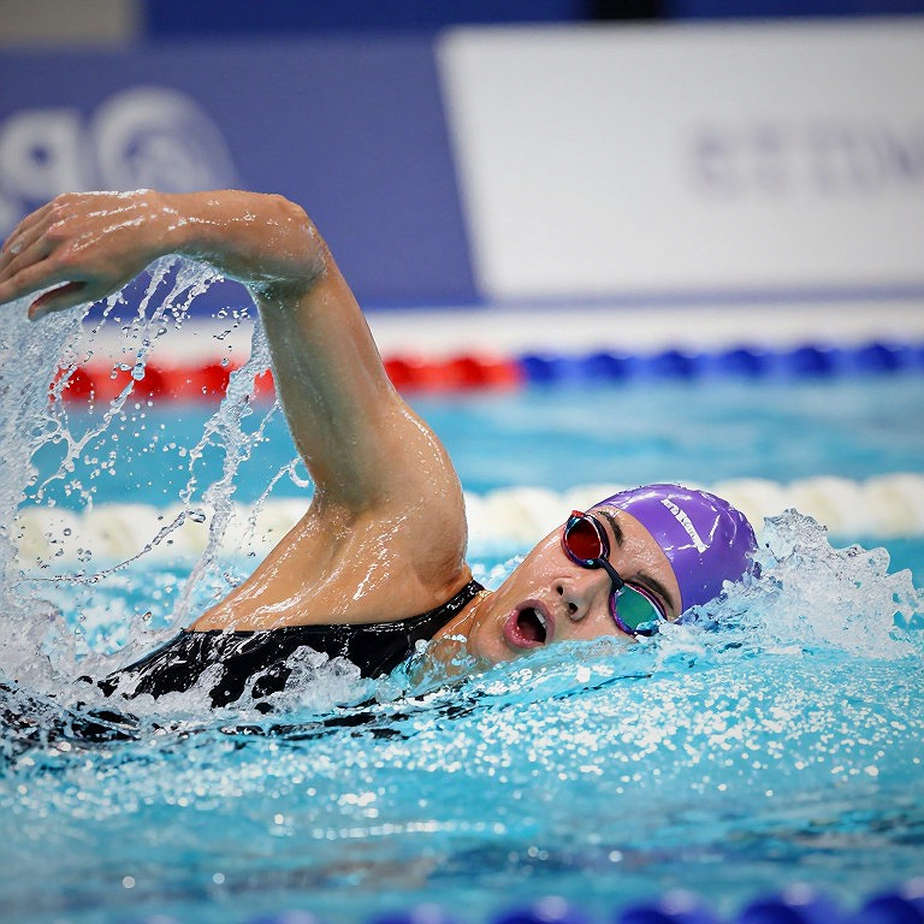
One detail is easy to miss: this was a season debut. Walsh has not yet entered the final sharpening phase of her training cycle. She swam 53.04 with a body that has not been pushed to its peak. The natural inference is that her technical ceiling sits at this level or above once she is fully prepared. But that inference carries a condition: it assumes this swim came before a taper, and the source says nothing about that. I keep the scepticism. My job is to read the evidence, not the belief.
From a governance standpoint, there is no grey area. The performance was ratified as a U.S. Open record, which means it passed the full officiating and timing protocol. No rule violation is indicated, no eligibility issue arises. The swimsuit sits inside the post-2026 textile framework, so no era screening is required. And there is no anti-doping content anywhere in the source material.
On career trajectory, Walsh is squarely inside her peak window. She is past her collegiate phase, training in a structured professional environment, and has already proven her capacity under pressure with seven golds in seven events. In sprint events, peaks tend to extend later than in distance events, so that window could stay open for another two to four years. The trade-off is that a heavy multi-event load cuts both ways. Seven events in one championship is a rare durability, and it is also the familiar road toward swimmer's shoulder. The source discloses no injury history, so I will not speculate, but I register the risk as a long-term variable.
The wider landscape of this event is very narrow. The three fastest times in history all belong to one person. When that happens, the concept of a rival almost disappears from the map. Women's 100-metre short-course butterfly currently operates as a one-athlete ecosystem, where the competitive story depends entirely on the health and motivation of a single swimmer. The source names no challenger in the chasing group, so I cannot draw a full tier map. That gap may reflect the narrow focus of the original report, or it may reflect something less comfortable.
Which brings us to the part swimming media tends to avoid. A 1.76-second season lead looks impressive, but it measures the strength of the field more than the ceiling of the leader. When the front-runner is more than two body lengths clear, the information you gain about the front-runner is minimal. You do not learn how good she is. You learn where everyone else is. A race without a genuine rival is a training session with a clock attached, and a clock in training never tells the whole story.
Beyond that, short course is the soft currency of swimming's record economy. It does not appear at the Olympic Games. It does not produce the moments a nation holds its breath for. It has its own world championship, its own audience, its own value, but it is not the arena where legends are defined. If Walsh sustains this level of dominance in a 50-metre pool, the story changes completely. If the margin shrinks once two turns disappear from the course, then everything being celebrated is a beautiful phenomenon of a narrow competitive format.
The "record machine" label is a trap as well. It is built on real evidence, on 11 world records and 14 American records at a single meet, so it is not an empty bubble. But the label creates an expectation only one person on the planet can satisfy, and that person is the one who has to live beneath it. Every time she steps onto the blocks, the public is not waiting for a win. It is waiting for a number. That is the kind of pressure that only reveals itself once it has already done damage.
I have seen something similar at a much smaller scale. In 2026, in Kuala Lumpur, I ran down to the track to interview Nguyen Thi Huyen moments after she won the 400-metre hurdles gold, sweat still on her skin. Three weeks later, digging through old archives, I learned she had suffered a serious injury in 2026 and nearly retired. Huyen crossed the finish line, and I crossed a boundary in my own journalism. Since then I have kept one rule: behind every line of results there is a person carrying something the scoreboard never displays.
For Walsh, what she carries is probably the expectation of another perfect season. The Trials at the end of the month will almost certainly call her name in the butterfly, and very likely in the sprint freestyles too. Selection risk at domestic level is low for an athlete who has gone seven for seven. But a one-shot trials format always carries a tail risk nobody can eliminate. One bad start, one botched turn, and an entire four-year cycle changes direction.
In silence, an athlete's heart beats louder than any roar. That afternoon in Charlottesville had no crowd screaming, no international broadcast cameras, nothing but the lane and the clock. And inside that silence, a 23-year-old swam the third-fastest 100 metres in the history of her event, then climbed out of the water as if it were an ordinary Tuesday morning.
What I take from 53.04 is not a record. It is a question about how we measure greatness. We have a swimmer faster than every woman who has ever swum this event, and we know less about her than she deserves, because her format does not sit inside television's prime time. If the next generation of Vietnamese swimmers takes anything from this case, I hope it is the discipline of reading a performance in its proper context: knowing which pool a record belongs to, which segment of the race it came from, and under what conditions. The rest, as always, will be swum by them.